
User Account Settings
After you log in to Tabidoo, you will find an icon of the figure in the upper-right corner. Here is where you can edit all your settings and personal data.
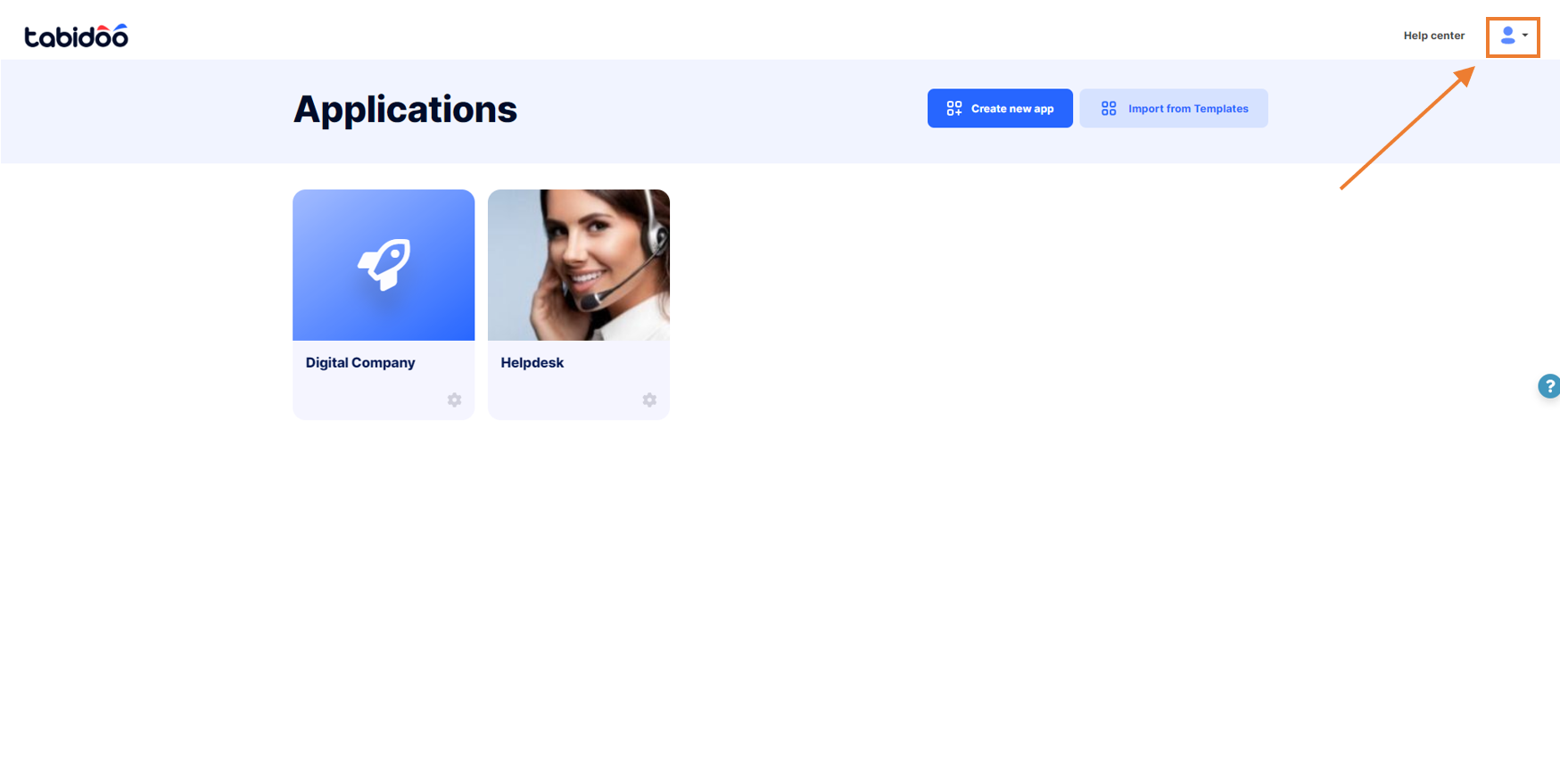
How to edit profile in Tabidoo
In the menu you will find:
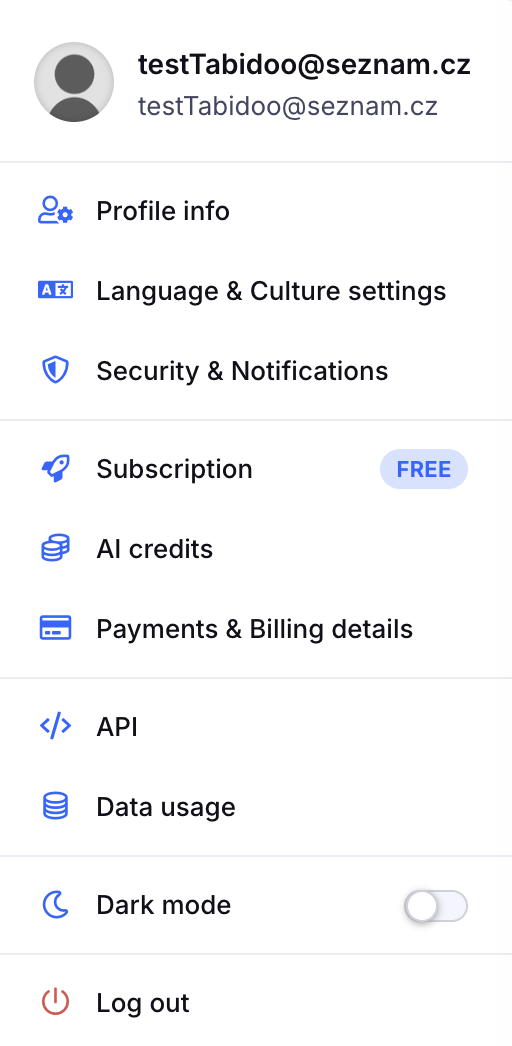
User account settings menu in Tabidoo
Profile info
- In this section, you will find your - name, e-mail, and valid pricing plan
- You can as well change your profile photo and nickname
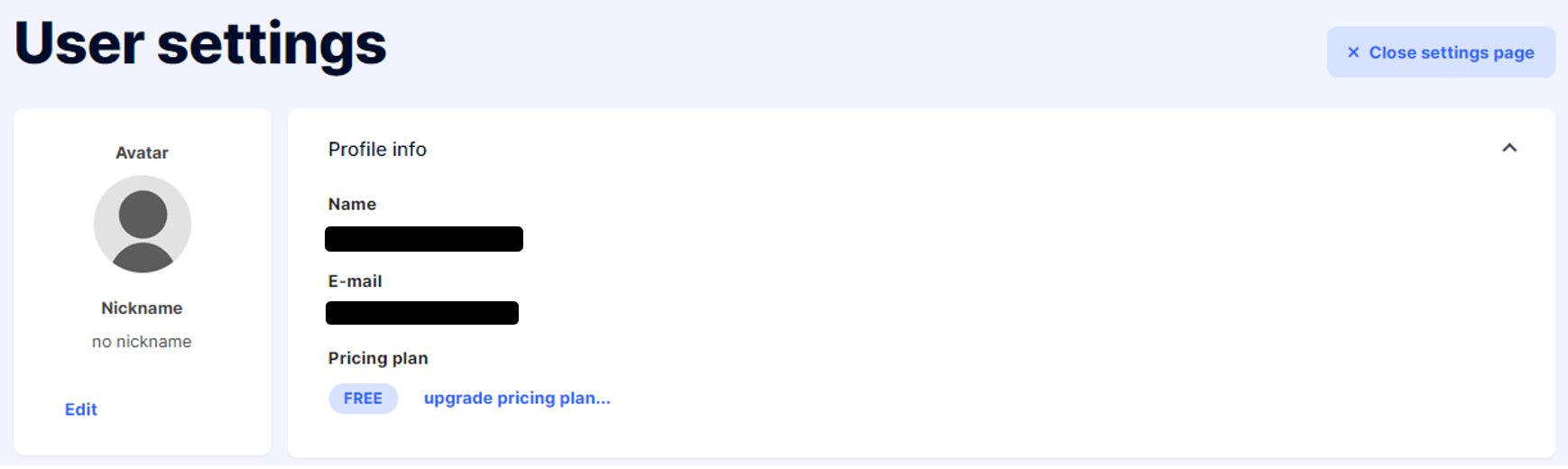
Profile info in Tabidoo
Subscription information
In this section you can see your active plan, you can upgrade it whenever to a higher or lower level. In case, you want the individual plan based on your special needs, feel free to contact our support.
The payment currency is locked after a credit card is added. To change the currency, you must first remove the existing payment method.
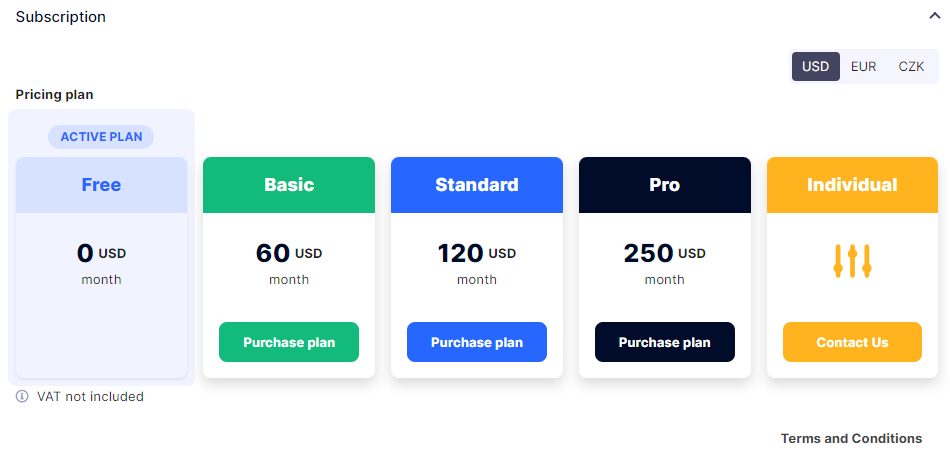
Subscription information in Tabidoo
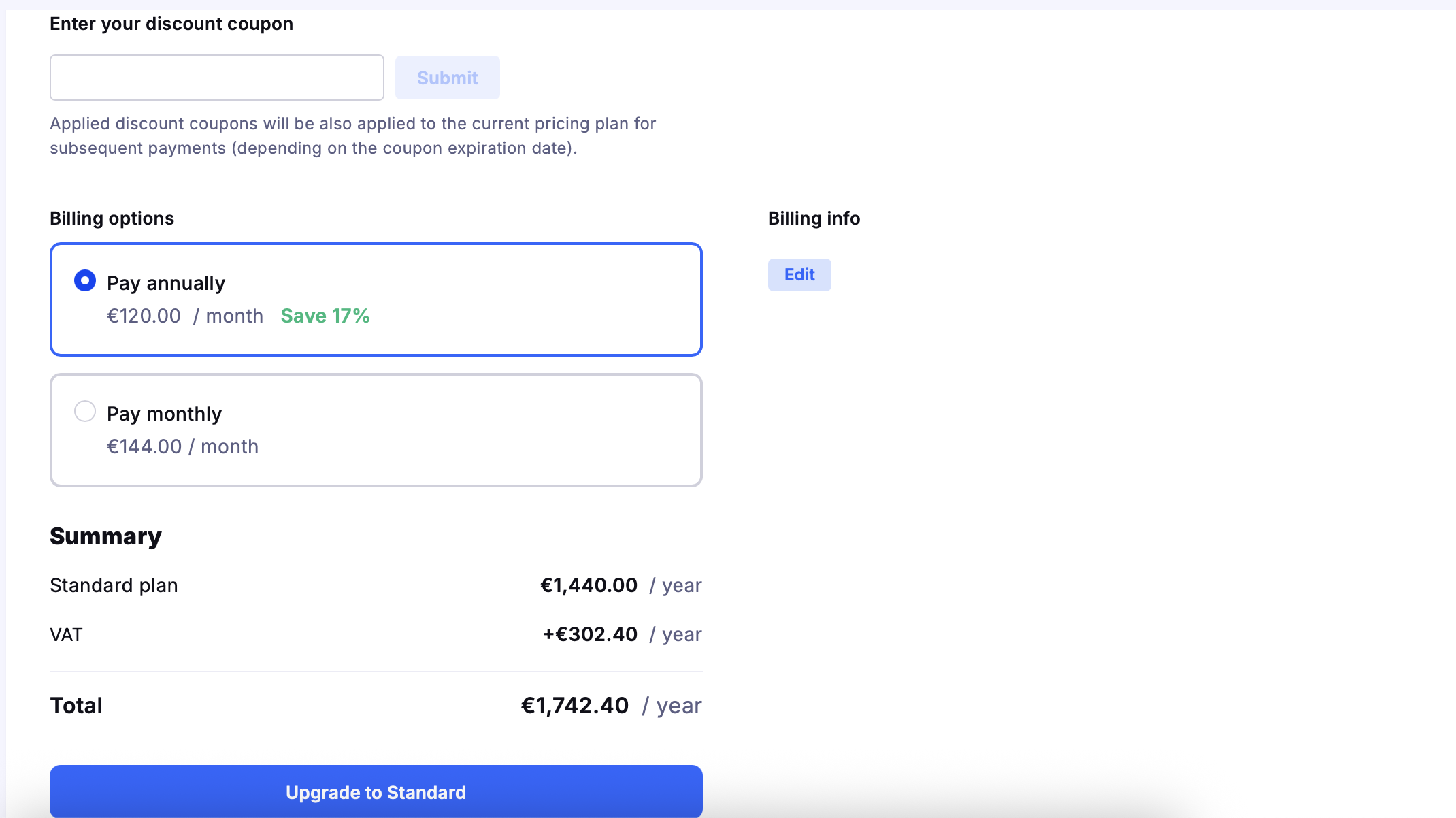
You can also enter a discount coupon in this section if you have one. Once applied, the discount will automatically be reflected in the pricing.
After that, you can choose between annual and monthly billing, and the system will clearly display the updated price for each option. The summary section below shows a detailed breakdown of the selected plan, including VAT and the final total amount.
AI Credits
Tabidoo AI features are powered by credits. Your usage depends on the complexity of your requests and the selected AI model.
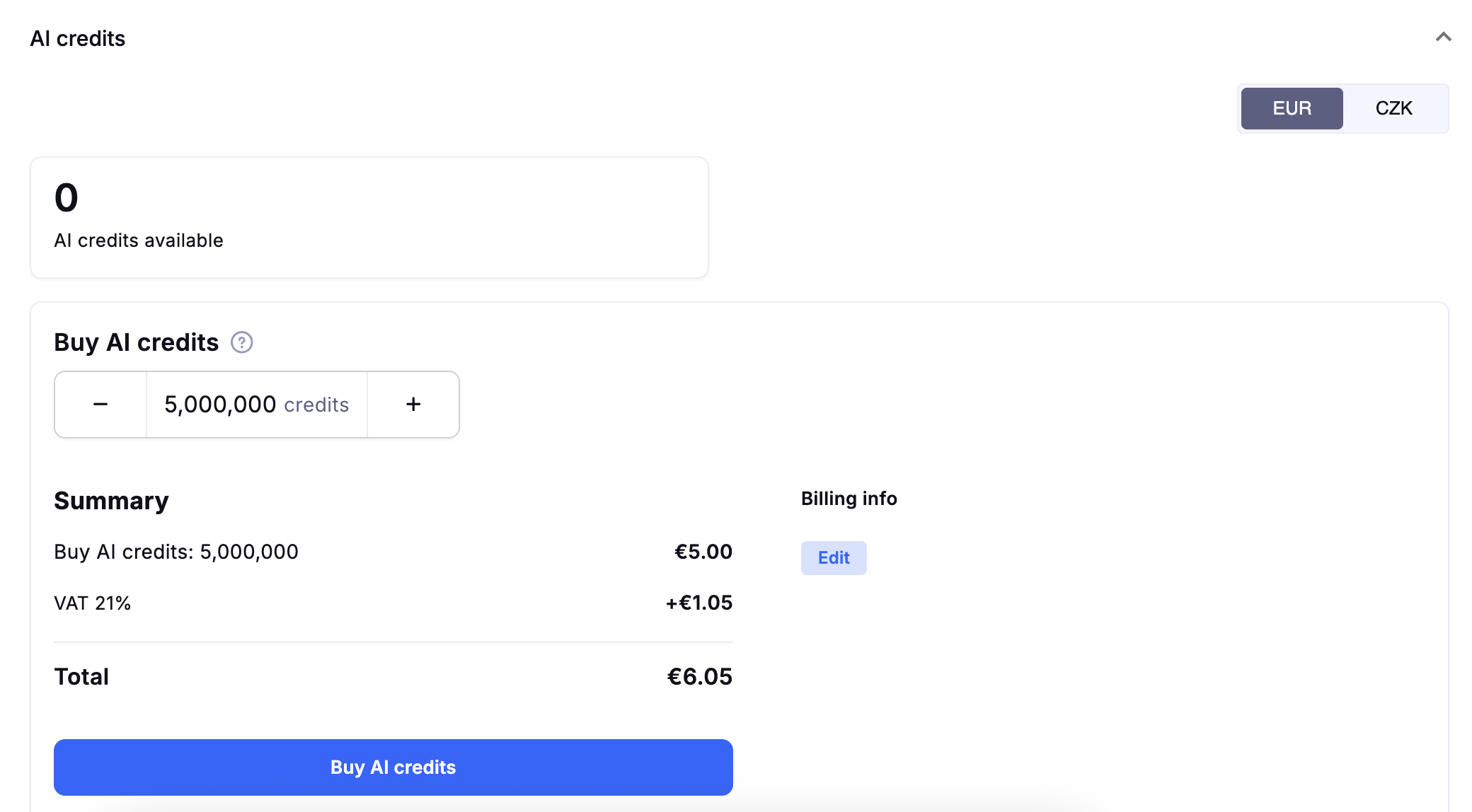
You can monitor your credit consumption and purchase additional credits directly in the application.
→ Learn more about AI Credits and how to purchase them:
Payments and billing info
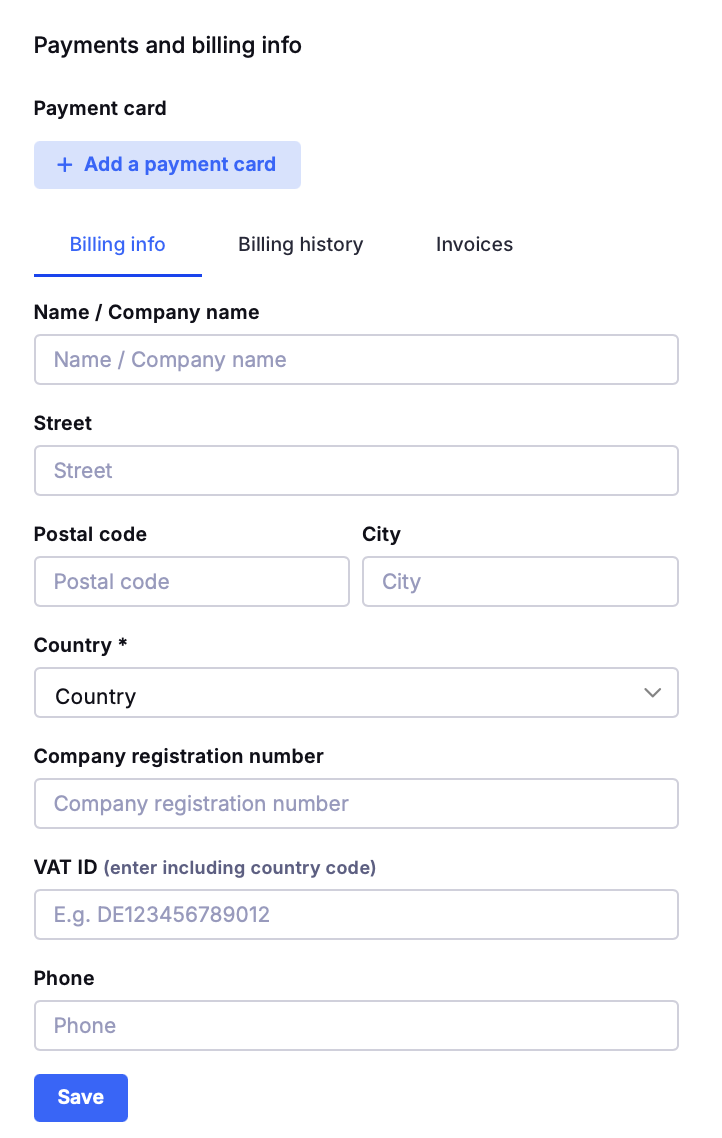
In the Payments and billing info section, you can manage your payment details and billing information.
You can add a payment card, which will be used for all subscription payments.
Note: You can change or remove your payment card directly in the Payments and billing info section. If your current card expires, remove it and add a new one.
In the Billing info tab, you can fill in or update your invoicing details, such as name or company name, address, VAT ID, and contact information.
The Billing history tab provides an overview of all past payments, and in the Invoices tab, you can find and download your issued invoices.
Language & Culture settings
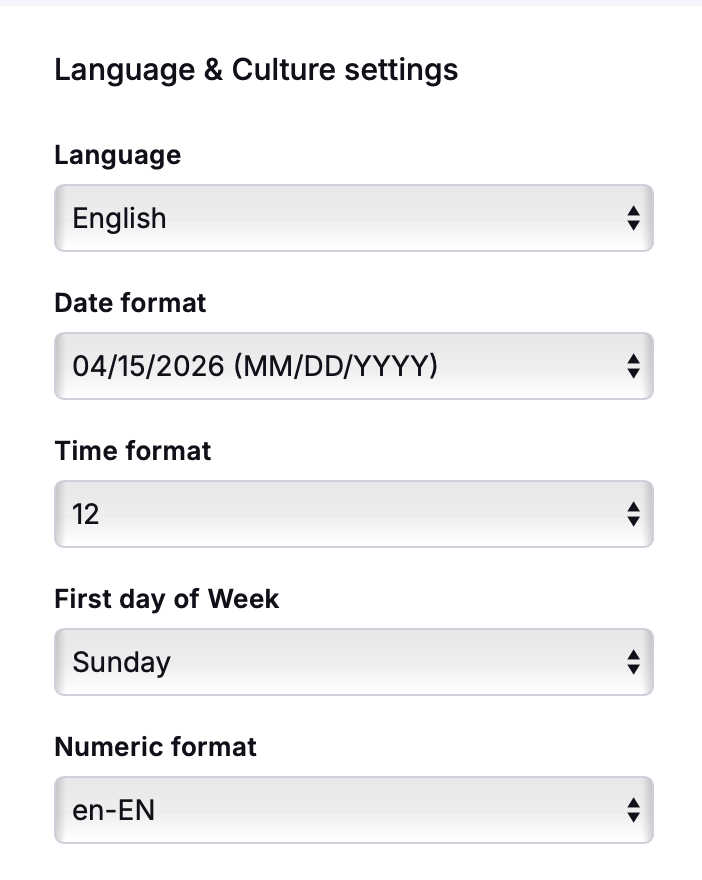
Tabidoo can be used in 29 languages. Can't you find your language? Contact us!
You can select your preferred language for the interface, as well as adjust regional settings such as date format, time format (12/24-hour), and the first day of the week.
Additionally, you can choose the numeric format, which affects how numbers, decimals, and separators are displayed throughout the application.
Security & Notifications
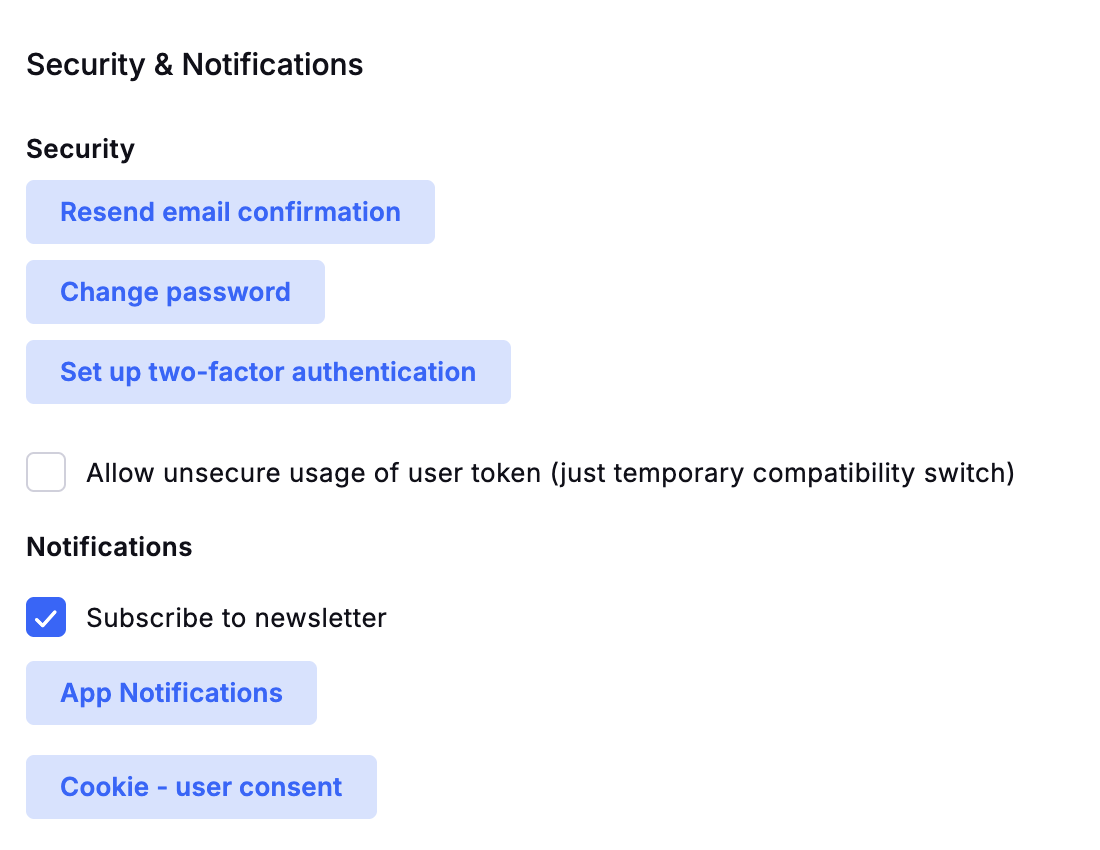
Security and Notifications in Tabidoo
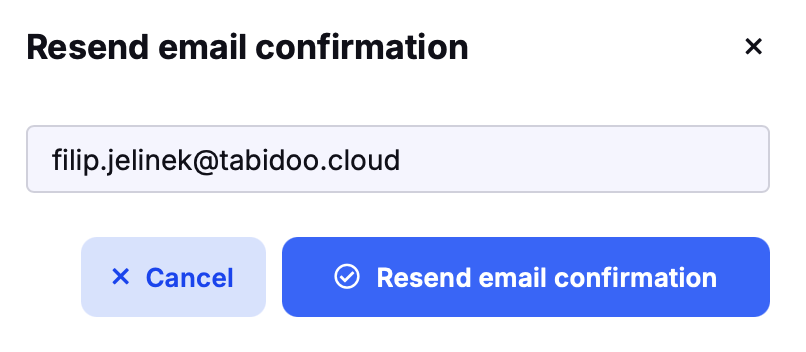
Resend email confirmation
Use this option if you have not received the email required to confirm your account.
The email address associated with the account you are currently signed in to is filled in automatically. Check that the address is correct, then click Resend email confirmation. A new confirmation email will be sent to your inbox.
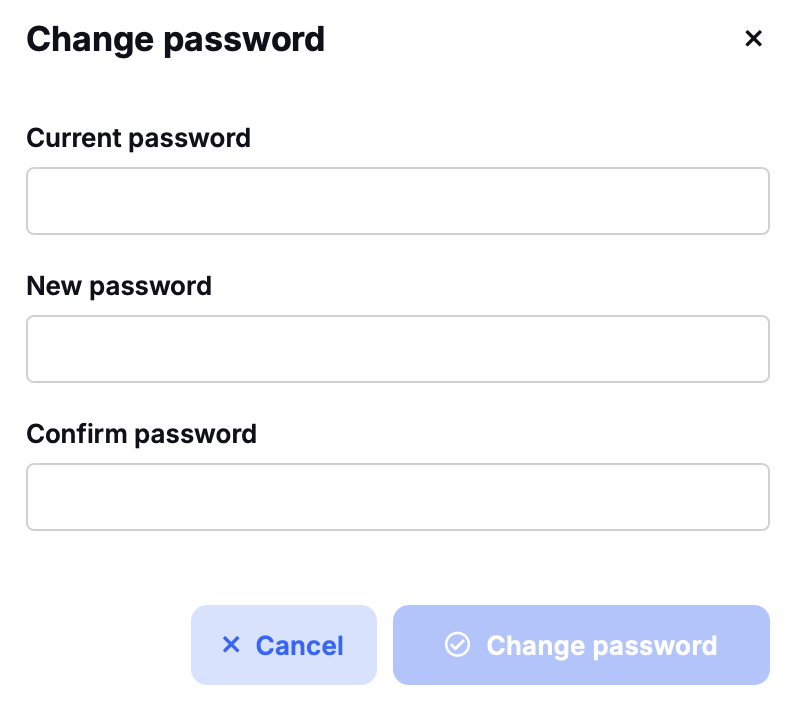
Change password
To change your password, enter your current password, choose a new one, and enter the new password again for confirmation.
The Change password button becomes available once all required fields are completed correctly.
Two step verification
If you have 2FA enabled, you cannot log in without a valid auth code! Before leaving the settings screen, make sure you have authenticator installed and that your settings are loaded correctly. Otherwise please disable 2FA. You will not be able to log back in without a valid code.
In case of a problem with 2FA, please contact us at support@tabidoo.cloud.
If you lose your authenticator, use Password Reset on login screen.
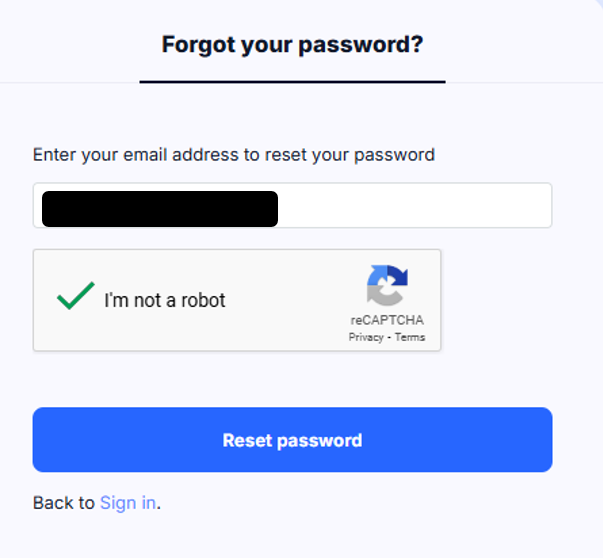
Then click on the link that will be emailed to you to reset your password. On the reset password screen you also have the option to reload the settings for 2FA.
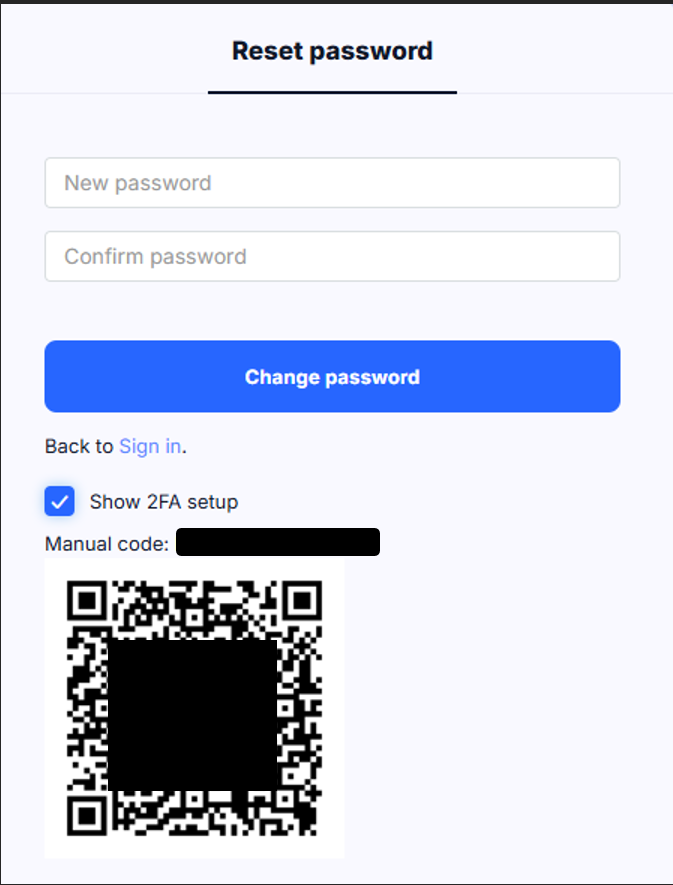
Of course, you don't have to change your password.
Cookie - user consent
User consent for the cookie bar can be adjusted in the Security tab of the User settings.
Allow unsecure usage of user token
A temporary compatibility option that allows the use of the user token in a less secure way. This option should only be enabled when required for compatibility with older integrations.
Subscribe to newsletter
Enables or disables Tabidoo newsletter emails.
App Notifications
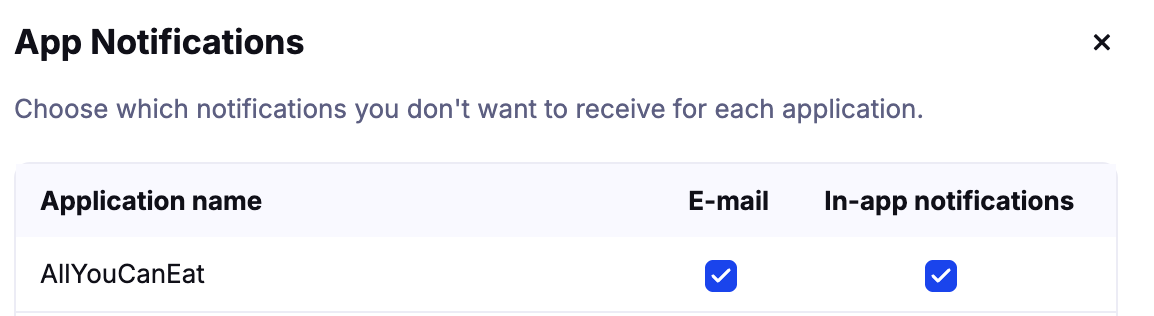
Allows you to manage notifications separately for each application. For every application, you can choose whether you want to receive:
- E-mail notifications
- In-app notifications
Uncheck the corresponding option if you do not want to receive that type of notification for a specific application.
Cookie – user consent
Opens the cookie consent settings, where you can review or change your cookie preferences.
API connection
In this section, you can add an API token to the application
Themes
You can enable or disable Dark mode in this section. This feature is currently available and allows switching the interface to a darker color scheme, which is more comfortable in low-light environments.

Data usage
Total usage
In this section, you can see an overview of your overall resource consumption within the platform. It includes:

- AI Credit – Displays how many AI credits have been used out of the total available limit.
- Applications – Shows the number of created applications compared to the allowed maximum.
- Storage for data – Indicates how much database storage is currently used.
- Storage for attachments – Shows the amount of storage used for uploaded files and attachments.
Applications overview
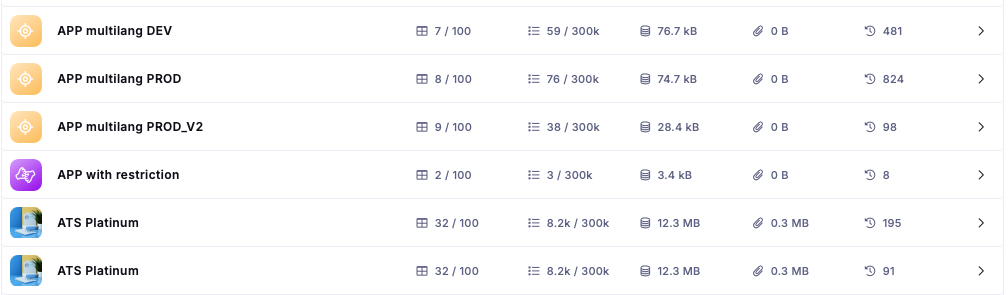
Below the total usage, you will find a list of all your applications with detailed usage metrics for each one. For every application, you can see:
- Number of tables / entities used
- Number of records
- Data storage size
- Attachment storage size
- Overview changes – Total number of audit log changes (tracked modifications within the application)
This helps you identify which applications consume the most resources.
Technical limits

This section shows daily limits related to workflows:
- Workflow Runs Count – The number of workflow executions used per day out of the allowed limit.
- Workflow Runs (ms) – The total execution time of workflows per day, measured in milliseconds.
If you need to access more detailed technical limits programmatically, you can use the following function:
await doo.environment.getCurrentUserTechnicalLimits();
More information can be found in the documentation
Paid applications

In this section, you can find a list of applications that are part of a paid plan. For each application, the following information is available:
- Original application – The base application template or package
- Used in application – The specific instance where it is used
- Pricing model – The subscription cost and billing frequency
- End of trial – The date when the trial period ends (if applicable)
Published paid applications
This section displays an overview of publicly published paid applications.

For each application, you can see:
- Application name – The name of the published application
- Downloaded – The total number of times the application has been downloaded
- After trial – The number of users who continued using the application after the trial period ended
This overview helps you track the performance and adoption of your published paid applications.
User-level

By enabling the Developer settings level, the user gains access to advanced configuration options within the application. This includes the ability to view and modify internal field names and access additional developer settings across apps.
In the Developer section, you can configure technical and API-related settings:
- Data provider – Select the database server used by the application (e.g., Mongo Public Server EU).
- Data provider for files – Define where files are stored (e.g., AWS Bucket EU Central 1).
- Application internal name – Set a technical name used for API and integrations.
- API settings – Enable validation of filters and sorting in API queries.
- Application owner – (Optional) Specify the owner of the application for identification purposes.
Tabidoo Labs

Tabidoo Labs is a space where you can try out new and experimental features before they are officially released.
Features in Labs are still evolving, which means they may change over time based on user feedback. By enabling them, you get early access to innovations like Tabidoo AI and help shape their future development.