
Lookup Settings
When you link tables in Tabidoo, a link-to-table field allows users to select records from another table. This interaction is powered by the lookup, which defines how records are displayed, filtered, and identified.
This guide explains how to configure lookup behavior and related features for the best user experience.
Lookup configuration overview
You can configure the lookup in three main ways:
- Columns in the lookup dialog – which fields are visible when selecting a record
- Filtering available records – which records users can choose from
- Record description – what text is shown after selection
What is a lookup
A lookup appears when you click a link-to-table field. It opens a dialog where users can select a record from a source table.
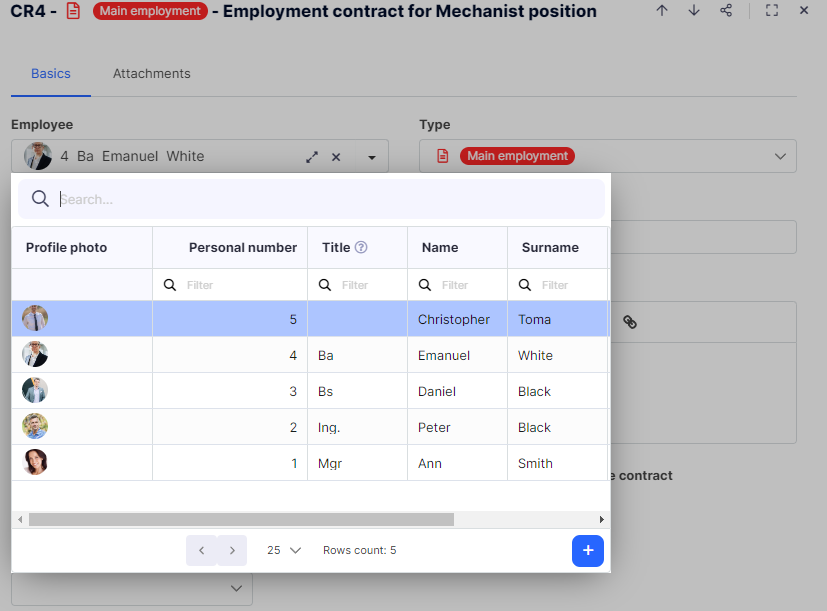
The lookup after linking tables in Tabidoo
Key idea: All column visibility and behavior in the lookup is configured on the fields of the source table, not on the link field itself.
Choose which columns appear in the lookup
To keep the lookup clear and fast, only show the columns users need when deciding what to select.
Steps
- Open the source table used by your link field (e.g., Employees).
- Edit each field you want to display in the lookup.
- In Advanced settings, enable Show in lookup table.
- Save the field. Repeat for any other fields you want to show.
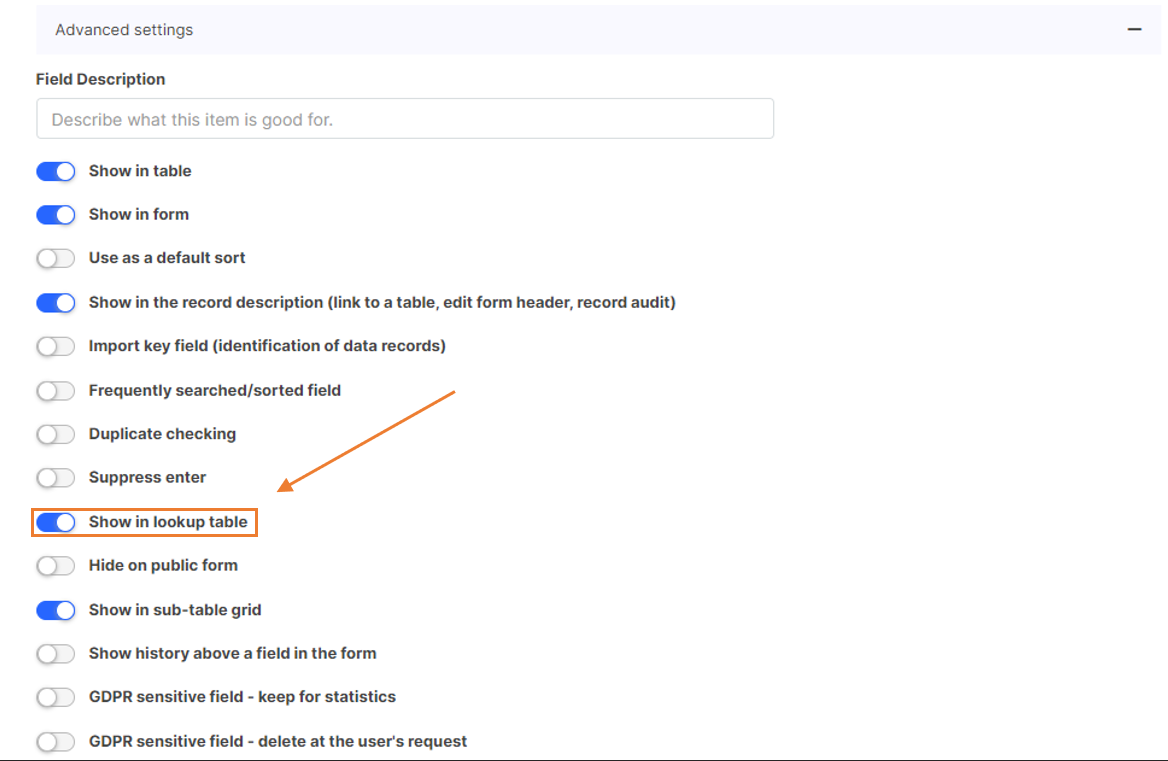
What will happen now?
Only the defined field (e.g. Profile photo, Personal number, Title, Name, Surname) will display in the lookup (see example below).
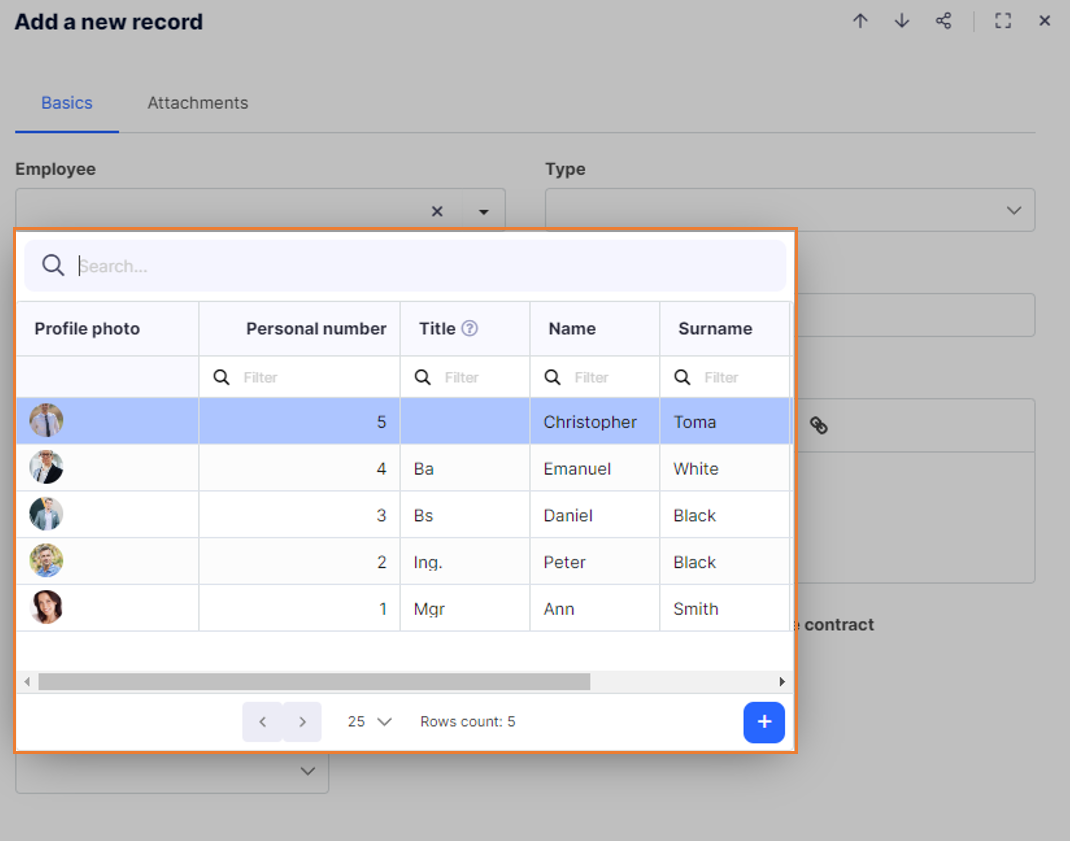
The lookup in Tabidoo
Best practices
- Show 3–5 columns maximum
- Include:
- Primary identifier (e.g., Name)
- Secondary identifier (e.g., ID, email)
- Optional status (e.g., Active/Inactive)
Filter the records available in the lookup
Sometimes you want to limit which records users can choose from (e.g., show only active employees).
Steps
- Open the table with the link field
- Edit the link field
- In Fixed conditions for loading linked table data, click + Add field for filter.
- Define filtering conditions
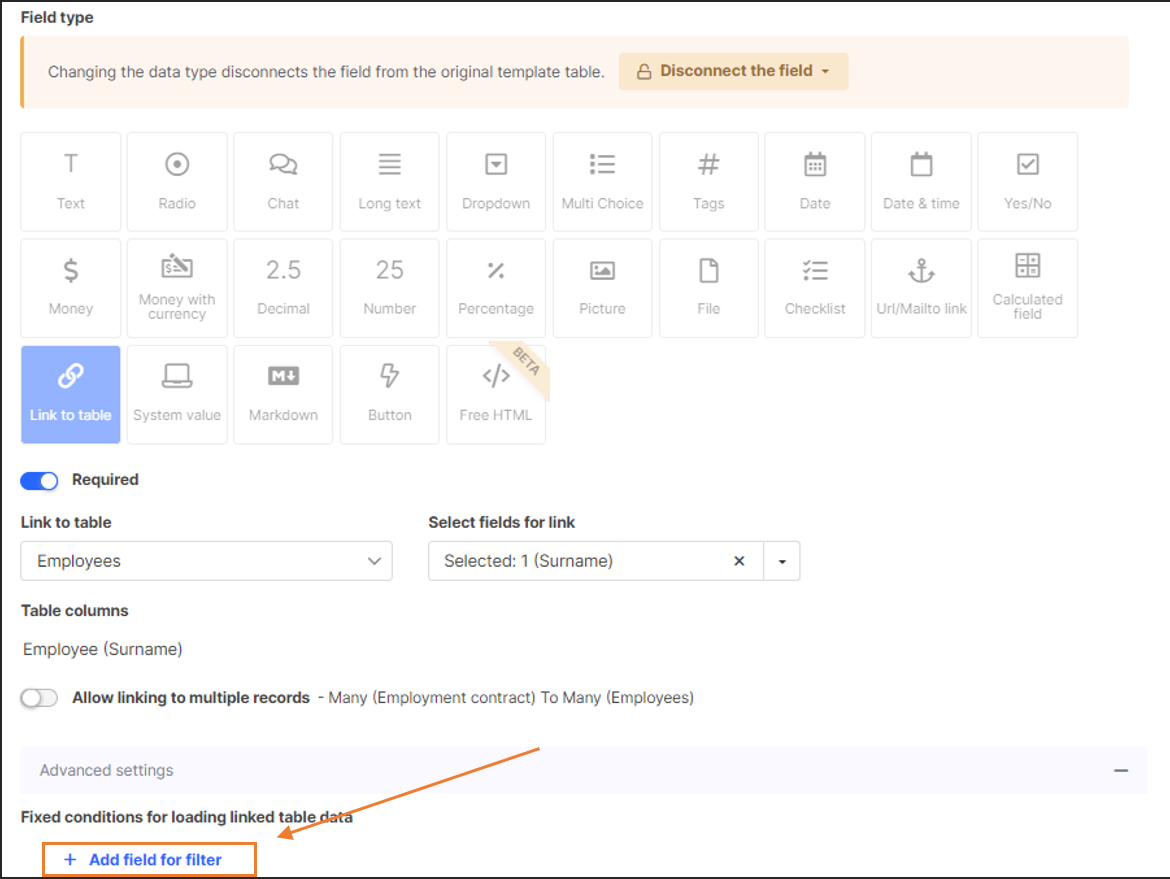
Add filter fields to restrict which records appear in the lookup
Example use cases
- Show only active employees
- Show only products in a selected category
- Show only contacts of a specific company
Why this matters
Filtering reduces errors and makes selection faster.
Record description (what users see after selection)
When you pick a record, the link field shows a compact “label” — the record description. You choose which source field(s) provide this text.
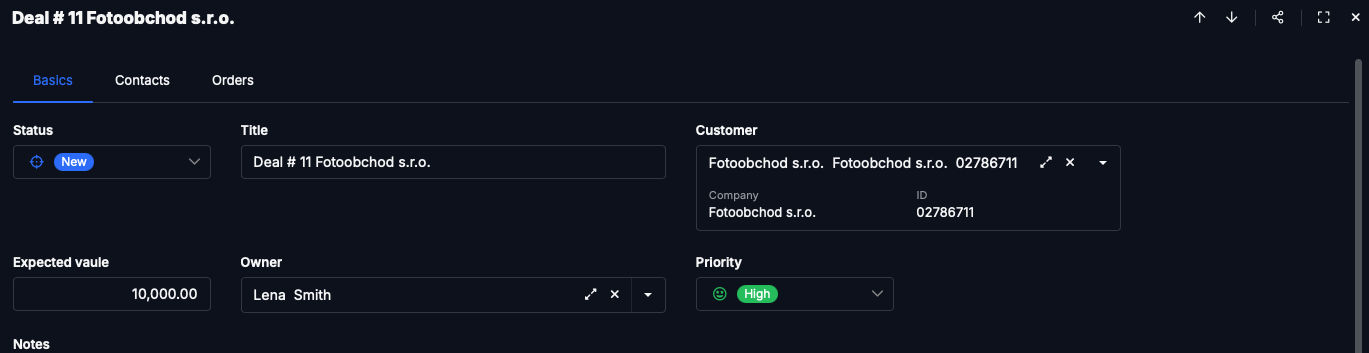
Company and ID in the record description
After selecting a record from the lookup, we want the Company and the ID to be displayed as the record description.
Steps
- Open the source table used by your link field.
- Edit the field(s) that should appear in the description.
- In Advanced settings, enable Show in the record description.
- Save.
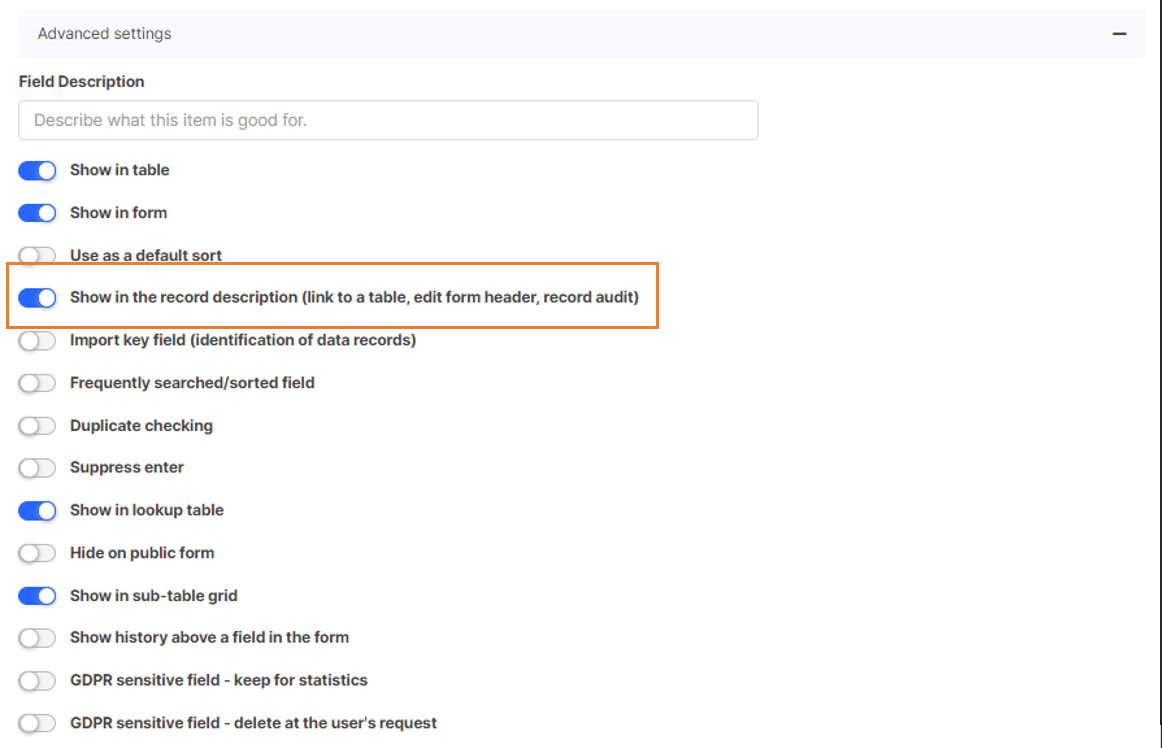
The option "Show in the record description" in the advanced features
Behavior
- If multiple fields are enabled, they are used in the field order
- The same description is used in:
- forms
- table views
- history (History → Description)
- integrations and API outputs the source table.
Best practices
Always combine:
- main identifier + context
Examples
- Jan
- Jan Novák (Developer)
- 10234
- Order #10234 – ACME Corp
Sub-table grid (child records)
Sub-table grid displays related records in the detail of a parent record.
Where it is used
- detail of a record (1:N relationships)
Examples
- Order → Order items
- Project → Tasks
- Company → Contacts
Important behavior
Sub-table grid only shows fields that have Show in sub-table grid enabled.
If you enable this option on only one field:
- only one column will be displayed
- no other fields will appear automatically
Real example
If in the Customers table you enable:
- Title → Show in sub-table grid
and no other fields are enabled,
then in any related record (e.g., Contacts → Customer link), the sub-table will display:
- Title (only)
No Company, ID, or other fields will be visible.
👉 This behavior is strictly controlled by field settings — nothing is added automatically.
Steps
- Open the source (child) table
- Edit fields you want to display
- Enable Show in sub-table grid
- Save
Best practices
Always configure multiple fields, for example:
- Name
- Status
- Owner
- Date
If only one column is shown, users often need to open each record to understand it, which slows down their workflow.
How these features work together
| Feature | Purpose | Where used |
|---|---|---|
| Lookup | Selecting a record | Forms, editing |
| Record description | Identifying selected record | Everywhere |
| Sub-table grid | Viewing related records | Detail view |
Advanced usage
Context-based filtering
Use filters to ensure users only see relevant data.
Smart lookup design
- Lookup = more information for decision-making
- Description = clean and minimal output
Multi-level relationships
Ensure consistency across:
- lookup
- description
- sub-table grid
History and audit
Record description is used in history logs.
Better example:
- Changed reference
- Changed Employee → Jan Novák (HR)
Common mistakes
- Too many columns in lookup
- Poor record description
- Only one column in sub-table grid
- Missing filters
Form design and record visibility (advanced)
Record description is also visible directly in the form header and linked field cards, which significantly improves orientation in complex forms.
Where it appears
- form header (linked records)
- link-to-table field (e.g., Customer)
- record preview card
Form designer enhancement
Using Form designer → Choose card fields, you can define which additional fields are displayed in the record card.
This works together with record description:
- Record description = primary label (what the record is)
- Card fields = additional context (details about the record)
Example
Customer field:
- Record description:
Fotoobchod s.r.o. (02786711) - Card fields:
- Company name
- ID
- Additional metadata
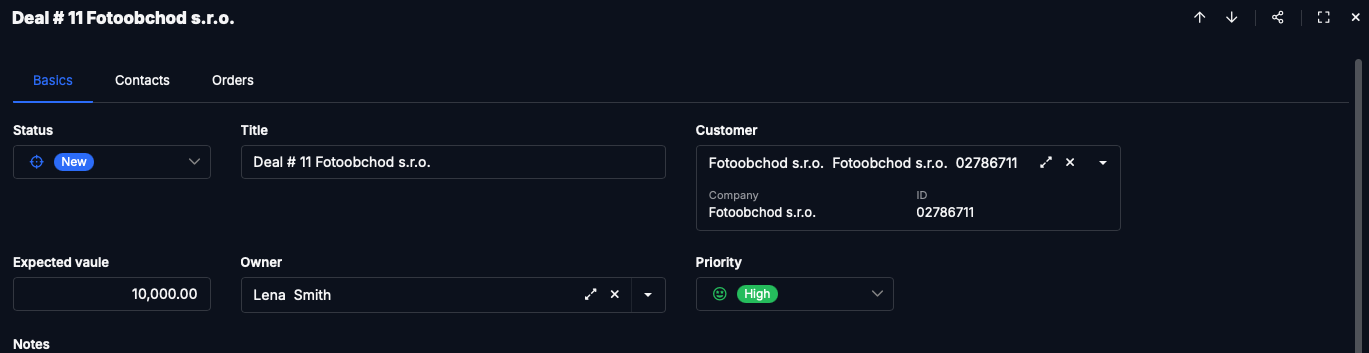
Result: user immediately understands what is selected without opening the record.
Recommendation
Always combine:
- well-defined record description
- carefully selected card fields in Form designer
This provides:
- better readability
- fewer clicks
- faster decision making
Summary
Lookup configuration in Tabidoo is not just technical — it directly affects usability.
A good setup improves:
- speed of user interaction
- data accuracy
- readability across the app
- quality of history and integrations
The key is balancing:
- Lookup columns (selection)
- Record description (identification)
- Sub-table grid (context)
When configured well, these features significantly improve the overall user experience.